
Odds and Ends of Art I like
Shift pattern Home
Jenny has arrived
Jen's vision
Gilmore's eyes
Guest Book
Cartoons
More Cartoons
Doris Day
Pictures of Doris
3 Films
Pics from the 3 films
Joss Whedon
Art
odds and sods art page
Photo
This is what I like!!!!
Edward Hopper
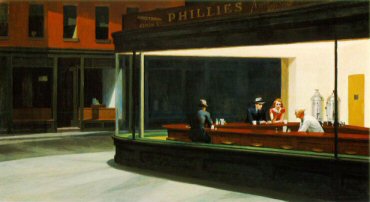
Just need to add something about hopper, "Hopper became a pictorial poet who recorded the starkness and vastness of America.
"He painted hotels, motels, trains and highways, and also liked to paint the public and semi-public places where people gathered: restaurants, theatres, cinemas and offices. But even in these paintings he stressed the theme of loneliness - his theatres are often semideserted, with a few patrons waiting for the curtain to go up or the performers isolated in the fierce light of the stage. Hopper was a frequent movie-goer, and there is often a cinematic quality in his work. As the years went on, however, he found suitable subjects increasingly difficult to discover, and often felt blocked and unable to paint.
Charles Burchfield wrote: 'With Hopper the whole fabric of his art seems to be interwoven with his personal character and manner of living.' When the link between the outer world he observed and the inner world of feeling and fantasy broke, Hopper found he was unable to create
Rene Magritte
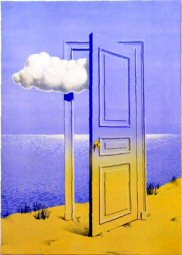
Magritte worked in a wallpaper factory, and was a poster and advertisement designer until 1926 when a contract with Galerie la Centaure in Brussels made it possible for him to paint full-time.
René Magritte described his paintings saying,
My painting is visible images which conceal nothing; they evoke mystery and, indeed, when one sees one of my pictures, one asks oneself this simple question, 'What does that mean?'. It does not mean anything, because mystery means nothing either, it is unknowable.
René Magritte described his paintings saying,
My painting is visible images which conceal nothing; they evoke mystery and, indeed, when one sees one of my pictures, one asks oneself this simple question, 'What does that mean?'. It does not mean anything, because mystery means nothing either, it is unknowable.
H.R. Giger
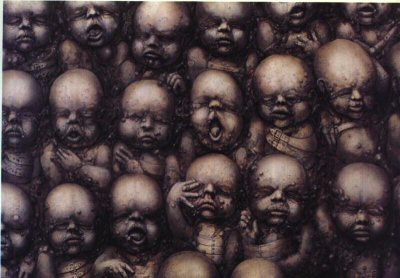
All things considered, H.R. Giger is probably most famous for his single enduring contribution to Western pop culture--his designs for the classic 1977 horror/sci-fi film Alien, for which Giger later won an Academy Award. The nightmarish title creature was actually inspired by one of Giger's original creations from his "Necronomicon" collection.
in 1978 he published a collection of works titled "Giger's Necronomicon" (the name comes from the fiction of early 20th century writer H.P. Lovecraft), a porfolio of images based in part on horrific nightmares the artist had experienced.
Giger once said that while trying to pass through Dutch customs with a portfolio of his pictures, he was refused entry into the country. This was due to custom officers mistakenly thinking that his pictures were 'photographs'. "Where did they think I could have photographed my subjects?" he remarked. "In Hell, perhaps?"
in 1978 he published a collection of works titled "Giger's Necronomicon" (the name comes from the fiction of early 20th century writer H.P. Lovecraft), a porfolio of images based in part on horrific nightmares the artist had experienced.
Giger once said that while trying to pass through Dutch customs with a portfolio of his pictures, he was refused entry into the country. This was due to custom officers mistakenly thinking that his pictures were 'photographs'. "Where did they think I could have photographed my subjects?" he remarked. "In Hell, perhaps?"
WILLIAM ADOLPHE BOURGUEREAU (1825-1905)
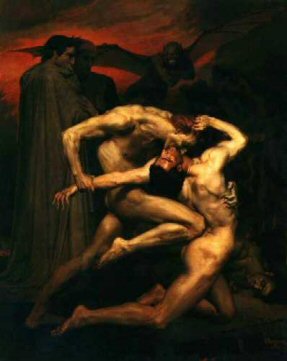
Bouguerau died in 1905.
Roy Lichtenstein
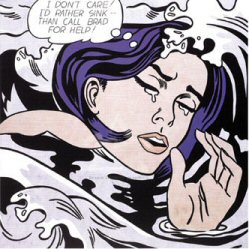
(Except from Carol Strickland, Special to The Christian Science Monitor)
"The mirrors were an interesting idea and the [paintings of] brushstrokes, besides the original cartoons. The interiors somehow broke some ground; I'm not quite sure why." Laughing, he concluded, "I hate to enumerate where I was brilliant." Lichtenstein's 1978 "Self-portrait," depicting himself as a T-shirt with a mirror as his head, sums up his lifetime of sly, probing art. We're all reflections of society, it seems to say, and it behooves us to examine critically the milieu we reflect. If Shakespeare's plays "hold the mirror up to nature," Roy Lichtenstein makes us look in the mirror of human nature.
I asked Roy Lichtenstein if he minded being called a Pop painter. The artist, who died Sept. 29, answered, "If people use the word 'Pop' art to differentiate it from art, then I wouldn't like that idea too much. It's inevitable I'm going to be called a Pop artist. The name is going to stick, no matter what I think." It's not a bad name to be stuck with. The 1960s Pop Art movement, launched by Mr. Lichtenstein and colleagues like Andy Warhol and Claes Oldenburg, brought popular culture into fine art. It made us look at the world around us with sharpened eyes. Always a provocateur, Lichtenstein appropriated the subjects and commercial style of cartoons and advertising. He used bold outlines, vivid colors, and stylized forms to simulate mechanical reproduction techniques, like his signature Benday dots. His subjects were initially from True Romance or adventure comics, as well as from the Yellow Pages.
"The mirrors were an interesting idea and the [paintings of] brushstrokes, besides the original cartoons. The interiors somehow broke some ground; I'm not quite sure why." Laughing, he concluded, "I hate to enumerate where I was brilliant." Lichtenstein's 1978 "Self-portrait," depicting himself as a T-shirt with a mirror as his head, sums up his lifetime of sly, probing art. We're all reflections of society, it seems to say, and it behooves us to examine critically the milieu we reflect. If Shakespeare's plays "hold the mirror up to nature," Roy Lichtenstein makes us look in the mirror of human nature.
I asked Roy Lichtenstein if he minded being called a Pop painter. The artist, who died Sept. 29, answered, "If people use the word 'Pop' art to differentiate it from art, then I wouldn't like that idea too much. It's inevitable I'm going to be called a Pop artist. The name is going to stick, no matter what I think." It's not a bad name to be stuck with. The 1960s Pop Art movement, launched by Mr. Lichtenstein and colleagues like Andy Warhol and Claes Oldenburg, brought popular culture into fine art. It made us look at the world around us with sharpened eyes. Always a provocateur, Lichtenstein appropriated the subjects and commercial style of cartoons and advertising. He used bold outlines, vivid colors, and stylized forms to simulate mechanical reproduction techniques, like his signature Benday dots. His subjects were initially from True Romance or adventure comics, as well as from the Yellow Pages.
Paul Delvaux
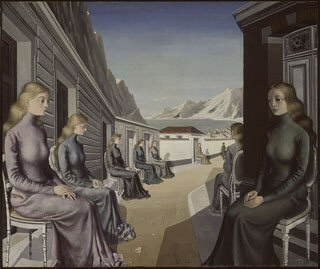
Although Delvaux associated for a period with the Belgian surrealist group, he thought of his art as a renewed classicism through which to convey the poetry and mystery of modern life.The paintings Delvaux became famous for usually feature numbers of nude women who stare as if hypnotized, gesturing mysteriously, sometimes reclining incongruously in a train station or wandering through classical buildings, accompanied by skeletons or puzzled scientists.
No nudes in this picture though!!!
No nudes in this picture though!!!